
Seasonality in a photographer's work – strategies to increase sales
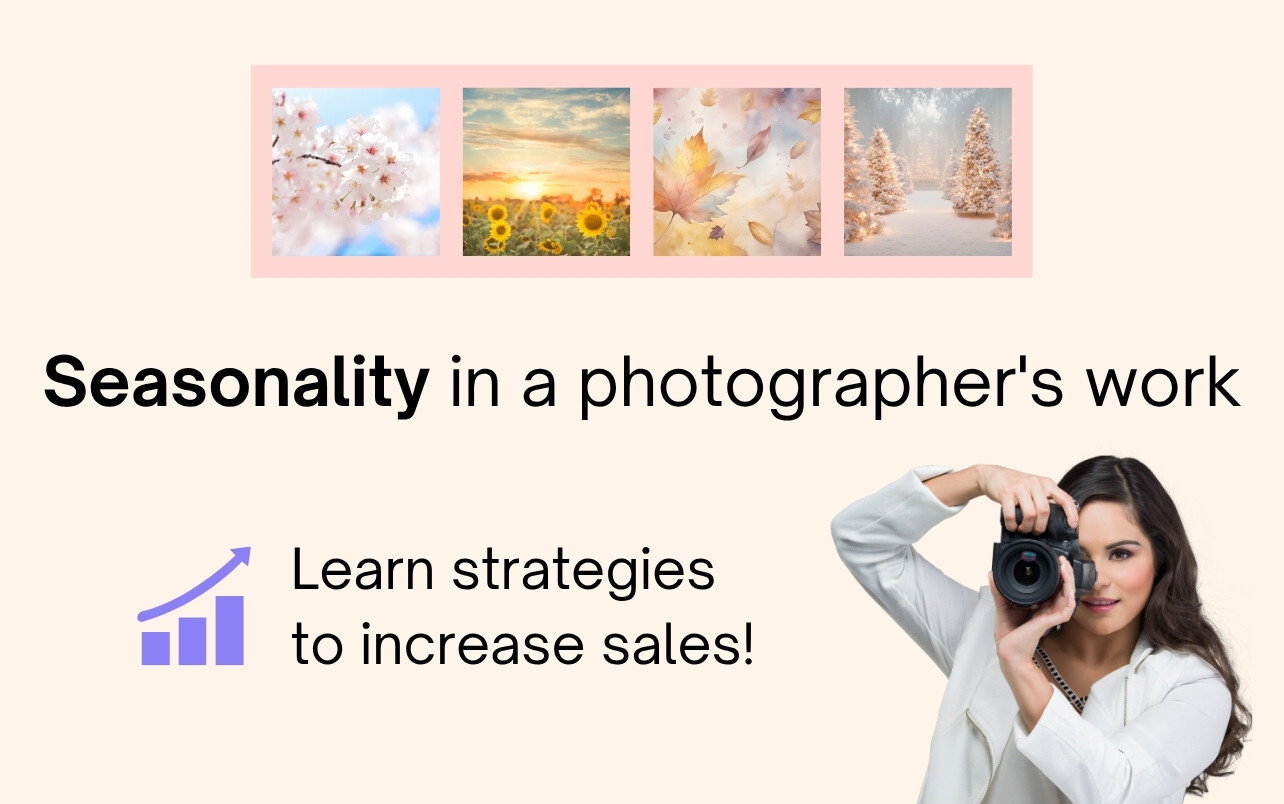
In a photographer's work, there are moments when the calendar is bursting at the seams – phones are ringing, the inbox is swelling with inquiries, and you try to fit three sessions into one weekend. And then… silence comes. Long, puzzling, annoyingly calm.
Sounds familiar?
Seasonality in photography is a topic rarely spoken about openly, yet every photographer faces it. The problem is that we usually react to it after the fact – when the season ends and we try to keep up the work pace.
Meanwhile, a well-planned year can completely change the situation:
more steady bookings,
a smarter pricing policy,
more effective campaigns,
and above all, greater financial peace of mind.
This post will not be about "magic tricks", but about consciously using what already exists – the natural demand cycles, which can be turned into a business advantage. Step by step, we will go through how a photographer can use seasonality to sell more predictably, effectively, and without the pressure of "last-minute" work.
So? Shall we plan the year together so that it works for you – and not against you? Let's begin.
Understand seasonality in photography
Seasonality is not an obstacle in running a photography business — it is one of the most predictable strategic tools you have at your disposal.
It is a repeating market rhythm that allows you to plan sales, offer preparation, marketing activities, and development in advance. The better you understand the cycles in your niche, the easier it is to predict when demand will appear, when to raise prices, and when to focus on building a portfolio and campaigns that will pay off in the coming months.
Natural demand cycles
The demand for photography services does not change by chance — it follows the rhythm of clients' lives. In some months, people plan big events, in others they return to work, and in still others they prepare for holidays or marketing campaigns. These repeating habits create natural waves of interest that look very similar year after year.
Ups and downs depending on the month and type of services
Every specialization has its own rhythm.
The wedding season kicks off with the arrival of spring and lasts until late summer. Business portraits usually explode at the turn of January and February, when companies and freelancers refresh their profiles, CVs, and image materials. Autumn is the favorite moment for family clients who want to use the weather and light, but also the busiest time for commercial photographers, because brands are preparing for their year-end campaigns.
There are also niches governed by even more specific dynamics. Christmas sessions can be booked as early as summer, even if they take place in November and December. Product photography becomes intense in autumn, during preparations for Black Friday and Christmas — this is when e-commerce works at top speed.
What sometimes surprises at first, eventually becomes obvious: the year is not even. It is a sine wave with clear waves of demand — and most importantly, these waves can be predicted with very high accuracy.
The key principle is balance: in moments of high demand you work intensely and sell your strongest offers, and in quieter months you invest in marketing, portfolio, and growth.
Thanks to this, your business works in harmony with the market logic, not against it.
Long-term cycles (e.g., wedding trends)
Apart from annual seasonality, there are also changes that happen slowly — over a few years. These trends decide which services grow, which styles become popular, and which skills are worth investing in.
For example: there is growing interest in natural, less posed sessions ("editorial look"), couples increasingly choose shorter reports instead of full-day ones, and winter weddings are becoming a regular alternative to summer dates. Average market rates also change, which is only visible when you compare your results from several years.
Short cycles (brand marketing campaigns, school periods, holidays)
In addition to big, annual seasons, there are also short, very intense "micro-seasons". They last from a few days to a few weeks and generate exceptionally high demand because they have a clear deadline — and this naturally raises the client's readiness to buy.
The strongest of them are, among others, Valentine's Day (couples sessions), Mother's Day (family sessions), Black Friday (e-commerce campaigns, product photography), or the beginning of the school year (business, student, and educational sessions).
These are moments when your service becomes "urgent", and a well-planned offer can generate sales well above average.
Analyzing data from previous years
One of the biggest mistakes photographers make is planning future activities "by feel". Meanwhile, what happened in the last 12 months is the most reliable source of data about the future.
How to analyze the order calendar?
The most important question is: When do you actually earn the most? The key is to recognize regularity — because regularity = predictability.
Review:
all completed sessions,
the number of inquiries per month,
booking dates vs session dates (these are often different moments),
campaigns or posts that preceded a growth in interest.
What is worth measuring?
Here are the four most important metrics that let you understand seasonality:
Number of inquiries – shows real demand.
Conversion of inquiries into sessions – reveals which months are "hot for sales".
Client sources – where they come from in specific seasons (TikTok? Instagram? referrals? Google?).
Revenue per month – the truest answer to the question of when your brand generates the most turnover.
It is also worth keeping a spreadsheet: Session / Inquiry date / Booking date / Session date / Client source / Revenue. After a year — you have a ready map of your business.
How to draw conclusions for the next year's plan?
By collecting the above data, you can answer a few key questions:
Which months require increased promotion?
Where should I raise prices because demand is high anyway?
Which offers are the "most seasonal"?
What marketing content works in a given cycle of the year?
Can I use any periods for upselling or new services?
Thanks to this, your calendar for the next year is not random – it is based on real data, predictable cycles, and a conscious sales strategy.
The most important seasons in photography — a market overview
Although every photography niche has its own dynamics, there are seasons that repeat for most photographers — and these are the ones responsible for the largest part of annual revenue.
Understanding their logic allows you to plan activities in advance, create better-tailored offers, and run marketing when clients are actually looking for services.
Below you will find a detailed overview of the seasons, based on real consumer behavior and industry trends.
Spring season (March–May)
Spring is one of the most dynamic and profitable periods, especially for photographers working with individual clients.
Why? Because spring is associated with refreshing — image, spaces, social media, portfolios. People are more motivated, brands plan campaigns, and the light and weather are perfect for outdoor shoots.
Strongest categories:
First Communion sessions (April–May),
outdoor family sessions,
Easter holiday sessions,
women's / portrait sessions (the "fresh start" effect),
business sessions – companies prepare materials for Q2/Q3.
Key photographer activities:
Publishing the outdoor portfolio as early as February.
Early promotion of First Communion mini-sessions.
Campaigns aimed at companies (branding, headshots, team sessions).
Raising prices in May — demand is high anyway.
Summer season (June–August)
Summer is traditionally one of the strongest seasons, but also one of the most demanding organizationally. It offers the best light and outdoor conditions of the year – which is why the demand for "outside" sessions grows. Additionally, it is the peak of the wedding season.
Strongest categories:
wedding reports,
outdoor wedding sessions,
holiday sessions (couples, lifestyle, travel),
fashion and commercial photography done "for autumn campaigns".
Key photographer activities:
Building a wedding portfolio as early as Q1 and Q2, so clients book services.
Ensuring high availability on weekends.
Introducing premium services (e.g., express retouching).
Production of materials for brands' autumn campaigns — a frequent "hidden season".
Autumn season (September–November)
For many photographers, autumn is the most profitable quarter of the entire year, especially thanks to brand campaigns and family sessions. Companies are closing projects, and individual clients want to capture the atmosphere of golden autumn. It is also a time of intense brand preparations for year-end campaigns.
Strongest categories:
business portraits — companies update their image for the next year,
"back to work" and "back to school" sessions (schools, universities, recruiting companies),
family sessions in autumn scenery,
Q4 product campaigns (Christmas, Black Friday, gifts),
first Christmas sessions in November.
Key photographer activities:
Promotion of autumn sessions as early as mid-August.
Cooperation with companies for product campaigns.
Planning Christmas mini-sessions well in advance.
Increasing availability during the week — more business inquiries.
Winter season (December–February)
Winter has a reputation as a "difficult period", but when well-planned, it can generate some of the highest short-term revenues.
All thanks to 2 strong demand impulses, which are: the holiday season and
the New Year (the desire for change and a "fresh start").
Strongest categories:
Christmas mini-sessions (November–December),
gift sessions (gift vouchers for Christmas),
New Year sessions (image, business),
studio photography — portraits, creative sessions, beauty, product,
brand New Year campaigns (Q1 start).
Key photographer activities:
Launching gift voucher sales as early as November.
Strong communication "New Year – new image" (ideal for business).
Creating studio content when the weather makes outdoor shoots difficult.
Introducing extra micro-services (e.g., quick CV sessions).
How to create a seasonal offer that sells?
A seasonal offer should not be a random discount or just another variation of the same package. Its effectiveness depends on how well you understand the client's needs at a given time of year — and how precisely you can answer them. The key is combining three elements: matching the service to the demand, building clear value, and planning the timing of communication.
Strategic package planning
The best seasonal offer is one that responds to the real needs of clients in a given period. You are not selling a "session", but a solution set in a specific context: a gift, a souvenir, material for a campaign, photos for a CV, a visual makeover, a Christmas album, or family photos before school.
Good seasonal packages usually take one of two forms:
-
Packages tailored to events of the year
First Communion, Christmas, New Year, image sessions to start the year, gift sessions for Mother's Day, business sessions for September, etc.
-
Packages tailored to the client type
for companies: "Q4 Campaign", "Team session + individual portraits",
for families: "Autumn outdoor session", "Christmas mini-sessions",
for individual clients: "New Year — new image".
It is not the number of photos that is most important here, but the logic of the moment when the client feels the need to buy.
Building a Unique Selling Proposition (USP) for each season
If your packages differ only in price and the number of photos — it is very easy to cause cannibalization. The client then chooses the cheapest or smallest option, and you limit your revenue.
That is why each seasonal offer should have a clear differentiator that is not present in the basic offer, e.g.:
a unique location available only in a given period (flower fields, autumn forests, Christmas scenery),
shortened delivery time (e.g., express delivery of materials before holidays),
a limited element (e.g., only 12 spots on a given date),
an add-on that increases value (print, album, extra retouching),
a photo style available only seasonally (e.g., pastel sessions, Christmas, outdoor editorial).
A limited offer works because it is both attractive and "time-bound". You create something that cannot be bought at any time of the year — this is the essence of FOMO, which generates traffic and faster purchasing decisions.
Optimal promotion timing
Even the best-designed package will not sell if communication starts too late. In photography, the worst mistake is to announce a season when clients are already doing it.
The general rule is simple: you promote seasonal offers 4–8 weeks before the planned demand peak.
Why so early?
Clients need time to make a decision, book a date, and agree on styling and budget. Brands — even more: they plan campaigns at least a month in advance.
Examples of an optimal schedule:
First Communion sessions – communication from February, sessions April–May,
autumn family sessions – communication from mid-August,
Christmas mini-sessions – communication as early as September,
Q4 product campaigns – communication from August, sessions September–October, publication in November.
Planning is the difference between stress and control. When promotion starts when clients actually begin searching, your sales grow without extra effort.
A photographer's calendar — a tool to scale sales*
A well-kept calendar is not just a schedule — it is the foundation for scaling a photography business. It allows you to control priorities, manage content, monitor seasonality, and plan marketing activities so that every action makes sense.
In practice, it is about creating three parallel calendars: marketing, content, and production. Together they form a system that allows you to predict revenues and prepare for seasons in advance.
Monthly marketing action plan
Every month of the year has its own dynamics and specific promotion opportunities — both for photographers working with individual clients and those serving companies.
What you publish should consider:
client motivations (e.g., New Year makeover, back to work, holidays),
demand intensity (is it a warm-up period or a sales peak),
platform specifics (TikTok likes process and backstage, Instagram aesthetic results, e-mail marketing facts and offers).
An example of yearly communication logic:
January–February: content "refreshing" image, CV, business, new projects,
March–May: outdoor shoots, First Communions, family sessions,
June–August: weddings, lifestyle, travel sessions,
September–October: business, schools, product campaigns,
November–December: Christmas, gifts, mini-sessions, Q4.
It is not about rigid frames – it is about rhythm. About making sure your content is synchronized with the moment when clients most often think about photos.
Content calendar
Content is the fuel of sales — especially in the photography industry, which is visual by nature.
A content calendar helps plan content in a way to:
educate clients (how to choose a session style, how to prepare, when to book a date),
inspire (portfolio, client stories, case studies),
sell (sign-ups for mini-sessions, new packages, last spots).
The best seasonal content is the one that anticipates client questions before they ask them.
Example? In September, you publish tips on choosing styling for autumn sessions. In November — "what to bring to a Christmas mini-session". In January — "how to prepare for business photos". Such content builds your expert position and automatically increases the number of inquiries.
Production calendar
This is the calendar that most photographers forget about — and it is exactly what decides whether you have something to show in the season.
It is about planning:
when you take sample photos to promote upcoming seasons,
when you organize test shoots (e.g., with models, brands, stylists),
when you create scenery or choose locations,
when you produce campaign materials (video, backstage, reels).
The biggest mistake is creating materials "after the season"
If you want to sell autumn outdoor shoots, you need material… in August. If you want to promote Christmas mini-sessions — your sample photos should be taken in September, not in November.
The production calendar turns chaos into a process. Thanks to it, your marketing will always be one step ahead of the season, not lagging behind.
How to use seasonality for upselling and cross-selling?
Seasonality is not just more traffic — it is also the perfect moment to increase the value of each order. When demand naturally grows, clients are more willing to invest in add-ons, upgrades, and expanded packages. In practice, this means you can build higher revenues not only by the number of sessions, but also by what you add to them.
The simplest form of upselling is package extensions:
extra shots,
premium retouching,
express photo delivery,
albums,
prints,
short backstage videos.
Clients often treat these options as a natural addition to the session, especially in periods when photos have special emotional value — holidays, First Communions, family sessions, or weddings.
Cross-selling works just as effectively, if you propose it at the right moment and in a logical context.
An autumn family session can lead to a Christmas mini-session.
A business session — to team photos or company interior photography.
A wedding report — to an engagement or anniversary session.
These are natural purchasing paths resulting from the client's needs, not from pushy sales.
The key lies in observing demand and proposing solutions that actually make sense in a given season — then the extra sale does not sound like an offer, but like help.
Price optimization depending on the season
Seasonality naturally creates space for a dynamic pricing policy — in periods of high demand you can safely raise your rates, and in quieter months introduce limited discounts or special packages that will encourage clients to book earlier.
It is important to communicate price changes clearly: not as a "price hike", but as an adjustment to real occupancy and the nature of the season. Clients react much better to messages like "last dates in the season" than to dry information about a higher price.
It is also worth emphasizing that the price reflects the value — your experience, quality, availability in key periods, and professional service. In a season of high demand, you do not just sell photos, but also a date that has real value.
Sticking to rates that are too low in these moments leads to working below market value, which is why it is worth arguing clearly where the price comes from: from demand, quality, and the results the client actually receives.
Communication and promotion of seasonal sessions
Seasonal promotion works best when it appears where the client is already looking for inspiration — on TikTok and Reels (process, backstage, storytelling), in a newsletter (a specific offer with a call to action), on Google and in local groups (when the client makes a decision).
Every platform has different dynamics, so it is worth adjusting the message: TikTok likes energy and stories, Instagram aesthetics and a series of posts, and e-mail — clear benefits and a limit of available dates.
See also: Photographer on TikTok – 10 ways to grow your brand
In seasonal communication, what counts are emotions, context and time. The client reacts not only to the aesthetics of the photos but also to the atmosphere: Christmas, spring, autumn, New Year.
Combining the mood with a clear time limit — "last 8 spots", "sessions only until December 10", "First Communion sessions: bookings until the end of March" — significantly increases conversion.
The most effective campaigns are those that combine emotions with urgency and accurately reflect the client's needs at a given time of the year.
Summary and strategic recommendations
Seasonality is not a phenomenon you have to "survive", but an advantage you can consciously use. When you treat it as the foundation of yearly planning,
your business stops being a collection of random ups and downs, and starts acting like a predictable system. Instead of reacting to what is happening right now, you can stay ahead of demand, prepare your offer early, plan communication in advance, and build a more stable revenue.
The key to sales growth is not working harder in the season, but smarter use of cycles that repeat every year: knowing when clients start looking for services, when they make decisions, and when they are ready to pay more for a date, style, or speed of delivery. Analyzing your own data, regularity of actions, and precise offer adjustment make sales a consequence of strategy, not luck.
It is worth creating your own "photographer's calendar" — tailored to your niche, client type, and work style. It can be a simple table, but it should include: demand seasons, content topics, seasonal packages, marketing activities, and a materials production schedule. Such a document allows you to plan the year like a project, not like a series of surprises.
The most important thing, however, is to take the first step now, not in half a year. Choose one season, prepare an offer for it, plan materials, and start communication earlier than usual. Just this one change will show you how much potential lies in conscious seasonality management — and how quickly it can translate into more stable, predictable sales.

An expert in marketing, copywriting, and sales. She has years of experience writing for the photography industry. At Mafelo, she shares her marketing knowledge and turns the news and tips we want to give you into great articles.
You might also like
How to collect photo publication consents in kindergartens and schools? New Mafelo features

A photographer's digital products. Why don't they sell themselves?

How to collect customer reviews? A guide for photographers