
Authenticity in the photo world – what does it mean?
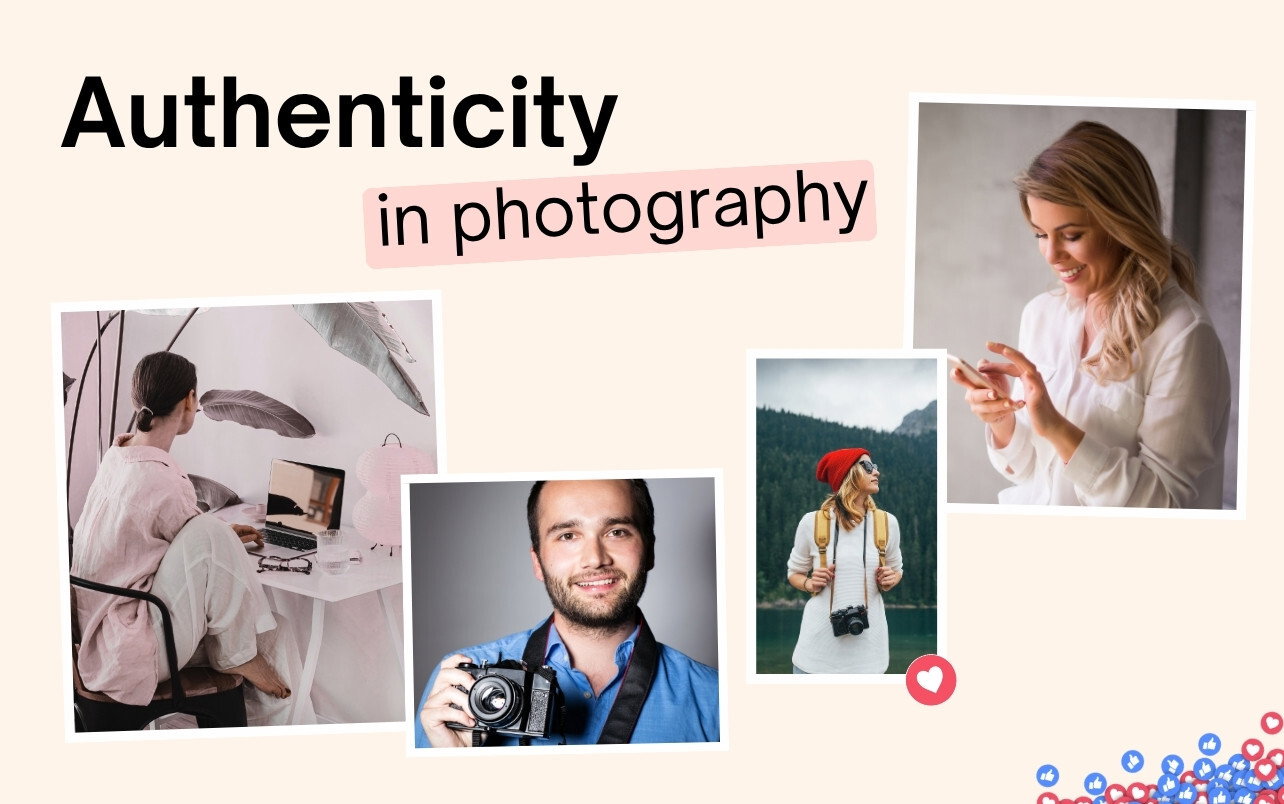
Authenticity is a word that is repeated in every possible way today. It appears in all marketing trends for 2026 and expert recommendations. But... what does it actually mean?
Is authenticity about showing behind the scenes of your work? Talking openly about the struggles of running a business? Being spontaneous instead of perfect? Or maybe just doing what you "feel", without looking at your reach?
In the photography industry, it is easy to get lost in this. On one hand, you hear that you have to be yourself. On the other – you see what gets clicks, collects views, and what currently "works". And here comes the tension: is it better to be yourself, or to do what has the biggest potential for reach?
In this post, we will look at this closer. I do not have motivational slogans and ready-made recipes for you. Instead, I will try to answer the question of how to keep authenticity in the photography industry and stop blindly chasing trends, while not giving up on growing your business.
Before we try to find an answer, it is worth stopping for a moment at the very source of this tension. Because very often the problem does not lie in authenticity itself, but in how algorithms work today and how much they affect the way photographers communicate online.
And this is exactly where we should start.
Algorithms and the photography industry – where does the pressure for "clicks" come from?
Algorithms themselves are not a bad thing. They were created to organize content and show users what – in theory – might interest them. The problem starts when we begin to treat them like an oracle and subordinate our whole communication to them.
In the photography industry, this pressure is especially strong. Visibility often goes hand in hand with the image: dynamic video, strong emotions, fast stories. So it is easy to conclude that if something gets clicks, this is how you have to act. That better reach equals better marketing. We often think that if a given format "carries", we have to copy it – even if it does not fit us at all.
As a result, many photographers start creating content not because they want to say something, but because the algorithm expects it. Instead of communicating their offer, work style, or values, they try to keep up with the changing rules of the game. And here comes tiredness, frustration, and the feeling that you are always one step behind others. Do you know this feeling?
So it is worth stating clearly: algorithms can support your visibility, but they should not define your identity as a photographer. If they start deciding who you are online and how you communicate, authenticity quickly fades into the background.
Authenticity in practice – what does it really mean for a photographer?
When we talk about authenticity in the photography industry, it is very easy to fall into another trap of definitions. Because authenticity is not one specific way of communication or a set of behaviors that "must" be implemented. It is not a post format, not a type of stories, and not a specific style of talking to the camera.
Authenticity starts much earlier – from the awareness of who you are as a photographer and who you really want to talk to. From answering the questions: how do you work with clients, what is important to you in photography, what atmosphere do you create during sessions. If these elements are consistent with what you show and say online, your communication becomes natural – even if it does not fit perfectly into current trends.
For one photographer, authenticity will mean calm, aesthetic content and rare posts. For another – energetic video, humor, and frequent contact with the audience. The key is not to choose a form of communication because "this is how it is done now", but because it is in line with your character and way of working.
Authenticity in practice also means agreeing to boundaries. You do not have to show everything. You do not have to talk about every difficult moment or share your private life if you do not want to. Being authentic does not mean being completely exposed. It means being real to the extent you are ready for.
And this is exactly where authenticity stops being a trendy slogan and starts being a conscious communication decision that can support your business – instead of burning it out.
Why chasing what gets clicks rarely works in the long run
Content that "clicks well" often gives a quick boost of satisfaction. More views, more reactions, sometimes new followers. The problem is that reach does not always go hand in hand with real interest in your offer. And it certainly does not guarantee relationships or sales.
When you create content mostly based on what currently has viral potential, it is very easy to blur your message. Today you do one thing, tomorrow something completely different, because "this works now". For the algorithm, this might be fine, but for the audience – not necessarily. A client who visits your profile tries to understand: who you are, how you work, if you are the one they want to trust with important moments of their life. If the communication is inconsistent, it is hard for them to judge.
In the photography industry, the decision to work together is rarely made on impulse. It is not a "here and now" purchase. It is a process where trust plays a huge role. And trust is not built by one viral post, but by a consistent, clear, and real presence.
Chasing clicks also often leads to creator burnout. You start doing things that do not give you satisfaction, just because "you have to". And even if it temporarily brings numbers, in the long run it takes away energy, creativity, and joy from photography. And this always, sooner or later, affects the quality of your work and communication with clients.
That is why it is worth asking yourself an important question: do you care about your content getting clicks, or about it attracting the right people? Because these are very often two different things.
How to find a balance between authenticity and visibility
Authenticity does not have to stand in opposition to visibility. It is not a choice: either you do your thing, or you are visible. The problem only starts when you try to be visible at your own expense.
Therefore, instead of asking "what gets clicks now?", it is worth starting with other questions:
what do I want to communicate?
who am I talking to?
what should remain from my online presence when the temporary trend is gone?
Balance starts with clear basics. If you know what kind of photography you create, who you want to work with, and what your offer looks like, it is easier to match the communication form to the content – and not the other way around. Algorithms can suggest formats or posting rhythm, but you decide on the message.
Visibility only makes sense when it leads to people who truly resonate with what you do.
In practice, this means conscious choices: not every trend is for you, not every form has to appear on your profile. You can use platform tools and mechanisms, but do it selectively – choosing what supports your work style and communication method.
Regularity does not have to mean intensity, and effectiveness does not always go hand in hand with maximum reach.
For many photographers, the biggest relief is the moment when they allow themselves not to play all the games at once. To focus on one or two channels, one communication language, and one consistent story. That is exactly when authenticity starts working in your favor – because it stops being a declaration and becomes the audience's experience.
Authenticity that supports business (and not just sounds good)
At some point, it is worth asking yourself a very specific question: what should my presence on social media give me? If the answer is "I want to have clients I like working with", then authenticity stops being an abstract idea and starts serving a very practical function.
Authentic communication in the photography industry works when it helps the client make a decision. When it shows not only pretty shots, but also the way of working, approach, and the atmosphere of the session. When it clearly communicates who your services are for – and equally clearly, who they are not for. It is this clarity that makes you attract "your" people, instead of trying to please everyone.
In practice, this means, among other things:
speaking in simple language, instead of marketing formulas,
showing real results of your work, not only idealized fragments,
consistency in communication, even if not every post has viral potential,
accepting that not every viewer will become your client – and that this is okay.
Authenticity that supports business is not about doing everything "by feel". It is about ensuring that your communication decisions are consistent with how you really work and how you want to be perceived. Thanks to this, social media stops being a stage to play a role, and becomes a natural extension of your brand.
And this is exactly where authenticity starts working the strongest. Not because it is a trend. But because it builds trust – and trust in the photography industry sells much better than any algorithm.
When it is worth letting go of "what gets clicks"
One of the harder moments in a photographer's development is realizing that not every form of visibility is worth your energy. Sometimes something gets clicks because it is loud, controversial, or fits a temporary trend – but not necessarily because it leads to real inquiries or meaningful relationships.
It is worth observing your own reactions after posting content. If after creating a post you feel relief that "it is over and done with", and not satisfaction, it is an important signal. Similarly, when you start avoiding your own content or you feel that you are communicating something you would not say to a client face-to-face. Letting go of such actions is not a failure. It is part of the brand's maturation.
Consciously giving up on some trends gives space for communication that is closer to you and your values. And paradoxically, it is often then that clients who truly appreciate your work style come to you.
Authenticity as a long-term strategy, not a temporary choice
Authenticity in the photography industry is not a one-time decision "from today I will be myself on social media". It is a process. Sometimes demanding, sometimes uncomfortable, because it means giving up comparisons, quick results, and the need to constantly confirm your value with numbers.
From the perspective of time, however, it turns out that such communication is the most resistant to changes in algorithms, platforms, and trends. Because it is based on what is constant: your sensitivity, work style, and relationships with clients. This is a foundation that you can develop for years, instead of building everything from scratch every season.
So if you feel tired of chasing what currently gets clicks, treat it not as a problem, but as a signal. Maybe this is the moment when it is worth coming back to yourself – and on this basis building visibility that truly makes sense.
Summary: authenticity is a process, not a format
Authenticity in the photography industry is not about stopping to care about what works on social media. It is about the fact that you decide which of these mechanisms are for you, and which are not. That not every clickable content has to be on your profile. And that visibility only makes sense when it leads to the right people.
If after reading this text you feel relief, and not more pressure – that is a good sign. Because building a photographer's brand does not have to be based on constantly adapting to trends. It can be based on consistency, conscious decisions, and communication that truly reflects how you work.
Checklist: is your communication really authentic?
Stop for a moment and answer these questions honestly to yourself:
Do I publish content that is consistent with how I really work with clients?
Is the form in which I communicate natural for me, or rather forced?
Does my profile clearly show who my services are for – and who they are not for?
After publishing, do I feel satisfaction, or only relief that "it is over and done with"?
Do I know why I am present on social media and what it should realistically give me?
Does my content build trust, or just reach?
If to some of these questions the answer is "I don't know" or "probably not" – it is not a mistake, but a starting point for change.
Finally
Remember that authenticity is not something you implement once and consider it "ticked off". It is a decision you make regularly – every time you create content, communicate your offer, and show your work to the world.
If you want to develop your photographer brand in a conscious, calm, and long-term way – it is worth drawing knowledge from places that are not tailored to reach as widely as possible.
That is exactly why we run the Mafelo newsletter. In it, we share expert knowledge in the field of marketing, communication, websites, and building a photographer's brand.
If you want to grow your photography business on your own terms, sign up for the newsletter and stay up to date with us.
https://zapis.mafelo.com/zapis-live

An expert in marketing, copywriting, and sales. She has years of experience writing for the photography industry. At Mafelo, she shares her marketing knowledge and turns the news and tips we want to give you into great articles.
You might also like
How to collect photo publication consents in kindergartens and schools? New Mafelo features

A photographer's digital products. Why don't they sell themselves?
How to collect customer reviews? A guide for photographers